http://www.umfm.com/programming/programgrid/213/


Throughout his career, Adam Rifkin has proven adept in almost every conceivable genre. He's directed some truly subversive entertainment (The Dark Backward; The Chase) and scripted clever family fare (Mouse Hunt; Small Soldiers) devoid of saccharine.
Fans of his charming first film, Never On Tuesday, will be pleased to learn that it’s finally being released to DVD this summer. Disappointingly, the disc will be barebones – the company apparently refusing to add the extras created specifically for it – I’d still recommend seeking it out, as it’s an unsung gem primed for rediscovery.

It’s a self-contained dramady in the desert as a group of twentysomethings (Peter Berg, Andrew Lauer and Claudia Christian) form a friendship following a car crash en route to
I had a chance to interview Adam for the DVD release of his latest project, LOOK, for Uptown Magazine. Here’s the full version that couldn’t be used due to space constraints.

What are the origins of LOOK?
The original idea struck me when I received a ticket from a red light camera. Apparently, I had gone through a red light here in
A few weeks later, the ticket showed up at my address with a photograph of me running the light. First of all, it was unnerving because it was a terrible picture of me. I was probably singing to the radio or something and my expression was very embarrassing. Aside from that, I found it disturbing that somebody was able to take my picture without my knowledge and mail it to my home address.
Then I just started to think what other cameras might be capturing without my knowledge. Everybody knows that there are cameras in banks and ATMs, but I was blissfully unaware just how pervasive they are. I suddenly started to realize that everywhere I looked I saw more and more cameras. Then I did a little research and I found out the average American was captured on camera over 200 times a day. I just thought that this could be an interesting way to tell a story. I’ve never seen a movie shot entirely with surveillance cameras before, and that’s pretty much how it came about.
Did you construct it as a traditional screenplay?
Stylistically, I knew I was going to film the whole movie through the point of view of surveillance cameras. When I actually started writing the script, I purposely forgot about that because I wanted the characters and the storylines just to stand on their own. I wanted this to be the kind of movie that would be compelling whether it was shot conventionally or not. I did purposely gear some of the stories toward what I thought would be surveillance-centric storylines. I felt I had to address things like terrorism, child abduction - things that we come to know as being iconic surveillance camera imagery. I also wanted to show how the cameras could benefit the people being photographed - that they could be seen as both good and bad things.
I believe that the issue of surveillance cameras and privacy laws is a very gray area. Some people say, 'The more cameras the better. I’ll gladly give up some civil rights if it means I’m going to live in a safer society.' Other people say, ‘This is a total invasion of my privacy. I don’t want cameras photographing me all the time. This is George Orwell’s nightmare come true.’ In my research, I found that there are compelling arguments for both sides. I didn’t want the film to take a stand. I wanted to show both sides and have the film spark the debate.
On technically achieving the reality:
I knew going into the idea that I wanted to maintain complete accuracy as far as where the cameras would be placed. We shot in locations where real surveillance cameras obviously were and we would put our cameras right next to them. We had a technical consultant who is a security expert on the set at all time to make sure everything maintained accuracy. I didn’t want anyone to be able to say that we cheated. When I was writing the script, I didn’t really think about exactly where the camera was going to be for the sake of the drama of the scene. I just knew that when we got to locations where surveillance cameras would be, I would only shoot the sequences from those perspectives.
When did you realise that the movie was more than just a gimmick?
It really started to come together for me when we started cutting it together, and when we started to add to the imagery, the time code stamp, and all those visual triggers that fooled you into believing that these can be real surveillance camera shots. Once we started adding those, and once we started degrading the image, making it look like real surveillance footage, I started to get very excited because the more it looked like real footage the better it was. My fear was that being wide angled, in high perspectives, and not having close-ups was going to make you feel too removed from the actors and the emotion, and was going to leave you cold. Especially for a character drama.
I later felt - when it started to look more and more like real surveillance footage - that those fears I had actually became the film’s strength. Because the more removed you felt, the more you felt like you were peering in on people’s lives from an objective perceptive, the more I felt that it put the audience in the world of voyeur. I felt that it added to the creepiness and the drama because suddenly the audience is complicit in something illicit. You’re suddenly a participant in something you shouldn’t be a part of. You watch a James Bond movie, and the audience is James Bond. That’s the fun of movies; you vicariously live out these adventures through the characters that you’re watching. LOOK continues to remind you that you’re not in the movie, you’re watching through the window.

Besides Giuseppe Andrews, who you've worked with before [Detroit Rock City], your cast is full of newcomers.
That was very intentional; when we started pre-production I said these have to be unknowns. Because we’re not going to fool people into believing it’s real surveillance footage and if a big movie star is playing one of the parts, it’s going to take you out of that reality. When we were presenting the script to the agencies, we told them that we don’t want stars, we just want your best actors. And for the first time in my career, the agencies were throwing stars at us. For of course, whatever reason, just our luck, because usually we’re chasing stars. And some very big names wanted to be in the film and it was very tempting to abandon my original idea and go with some of these big names because it adds so much value to an independent film. Ultimately, I stuck to my guns and felt it was important, creatively, that the characters maintain that realism. I feel creatively I made the right decision, if I had gone with some of these stars, I’m sure I would be a lot richer right now, but I’m okay with that.
And you also have John Landis in a cameo.
John’s always been sort of my mentor. When I was 21 or so, I just finished my first film, and had never met him before, but I was a huge fan so I contacted him and asked him if he’d watch my film. He invited me to the Universal lot and screened it, and took me to lunch, and he was very generous with his time. After that, whenever I wrote a script, he’d read it or he’d give me ideas if I was about to make a new movie.
He’d help me – like when I made the movie The Chase, I had never directed action before, he gave me insight on how to analyse an action scene. He’s really been, like I said, very much my mentor, and as the years have gone on, he’s just sort of evolved into a good friend. So, when I needed a famous
What's been the most satisfying part of making the film?
One of the things that was really great about this experience was the creative freedom as a filmmaker when you’re making a movie that’s “under the radar”.
We basically just did what we wanted, and when you get to explore, and be experimental in that way, because you’re not spending a lot of money, you don’t have a lot of people looking around your shoulder. It enables you to flex some creative muscles that you otherwise might suppress if you’re working for a studio. In terms of the reaction to the film, we thought making a movie that was very much an experiment; it was a very risky proposition to see if the idea would even work. The fact that the reaction has been so positive has been really exciting. The idea that people have embraced the movie even though it’s been made in such an unconventional way, all the fears I had going it that it wasn’t going in or was this idea worth exploring, it put those to rest. And it really feels good.
Would you work so unconventionally again?
I hope I always get the opportunity to always do unconventional things. I will tell you that LOOK has spawned a television series that we’re prepping right now - once again, we’re going to shoot entirely from surveillance cameras. I can’t tell you for which network yet, because we haven’t made a formal announcement, but what I can tell you that it’s a premium pay cable network and it’s going to start shooting in four weeks. We have eight episodes that we’re going to do.
Suffice it to say, it’s a channel that we can show the things, and say the things that will enable the show to be as controversial and as bold as the movie. We’re not going to be saddled with standards and practices telling us we can’t do things.
Would it be following the same characters as the movie?
The only characters that we’re going to follow are the Giuseppe Andrews character and his buddy played by Miles Dougal. That storyline continues through the series and all the other characters are going to be new.
How different is your process when writing scripts for other people to direct?
My theory is that I love movies for other people. My favourite thing to do is write and direct. I mean, first off, that’s my passion, that’s what I always wanted to do since I was little kid. When I get an opportunity to do that, I cherish it. Being a writer/director of a project, there’s nothing more satisfying than to have an idea, and to see that idea through to the screen.

It’s an entirely different experience when I write something for somebody else. In many instances, you know, it turns out very differently than the way I imagined it when I was writing it. But that’s okay because filmmaking is a director’s medium and so when I write something that I know I’m not directing, I know that whoever is the director is going to take it and run with it and interpret it however he or she wants to. It’s all kind of the fun of the experience to see how somebody else interprets your words. I interpret my words one way, other people would interpret them another way.
I feel very fortunate that I had the opportunity to write some movies that have gone to be big studio hits. It’s really neat, and I want to keep doing it, as often as possible. Also, too, when I get to do those things, those opportunities afford me the freedom to take the time to do a movie like LOOK. Listen, the same year, that we were shooting LOOK, Underdog, which was a movie that I wrote, came out. Right, so the budget of Underdog was $100 million dollars and LOOK’S budget was probably less than the dog food budget for Underdog. But to me, I always want to be able to have one foot in both worlds. The big studio world and the independent world because, in each one, gives you an opportunity to flex different muscles. Guys that I really, really admire like John Cassavetes and Orson Welles did it that way and John Sayles does it that way.
Who are some of your other influences?
I’m a huge Woody Allen fan. I obviously worship the same gurus that so many other filmmakers worship. Francis Coppola, Martin Scorsese, Hal Ashby, Billy Wilder, Stanley Kubrick. I love those guys. But you know what, I love all kinds of movies. I love B movies, I love arty movies, I love foreign movies, I love big
What were some of the bad movies that inspired you?
It’s tough to say. There’s so many, let me try to narrow it down. When I was a kid growing up, there was a movie that came out called Up The Academy. It came out during the Animal House, Porky’s, teen comedy era. It was presented by Mad Magazine, so it was called Mad Magazine presents Up The Academy. Now, it was a financial failure, and it’s not remembered as a particularly good movie. I wouldn't even consider it a good movie myself. But when I was making
I will say this. Up the Academy has one of the best soundtracks. There are some great songs in that movie. I listened to that soundtrack over and over again during pre-production of

And the soundtrack for
We used a couple songs from The Sweet, all kinds of obscure songs; we used Black Superman, the Muhammad Ali song, and the Pina Colada Song by Rupert Holmes.
We also used some great rock and roll songs. The way we got the soundtrack was that when were editing, we used all the songs we wished we could have but knew we could never afford. The budget for the music of DRC was pretty high in the budget. We had $500 grand going in. But we put in every song we wanted for the first test screening, knowing that after we’d have to come back down to reality and strip it of all the songs we couldn’t afford and figure out ways to score the rest. The test screening went so well, and the scores were so high, that the studio said just pay for all the songs. Just lock the songs where they are. So in one momentary decision by Bob Shaye, the chairman of New Line Cinema, the budget of the soundtrack went from $500,000 to $2.5 million dollars. It was amazing.

That’s a film that you directed that you don’t have a writing credit on.
My friend Carl Dupre did the original draft. I did do a lot of writing on it, but I didn’t want to take credit away from him. Giving him an opportunity to take sole credit was the right thing to do. He was the assistant editor on The Chase, and I had read the original draft of DRC way back then.
When I got Bone Chillers going on ABC, I hired him and another assistant editor that I had worked with too. The two of them were both very funny, and they were friends, so I hired them both to be a writing team on that show. It was actually the most highly rated show of the children's lineup, but the same year Disney bought the network, and they canceled everything they didn’t own. So it suddenly changed to all Disney programming. It was sort of like the last gasp of Saturday morning programming for kids.
What are some things you’re working on now?
I wrote a graphic novel that just came out called Schmobots - a comedy about slacker robots. It's published by Boom Studios, so I’m excited about that. My full time job right now is the LOOK television series, and we’re getting ready to shoot that in just about 4 weeks.

Here's a longer version of my interview with Ed Naha that ran in Uptown.
Starting out with Roger Corman's company, he wrote everything from comedy to fantasy before pairing up with Stuart Gordon for one of the best killer-toy movies ever made, Dolls, and the original version of Honey I Shrunk The Kids. Speaking with
What were the challenges of adapting a well known story?
So you were you influenced by both the Bible and the DeMille film?
Did writing for animation free you up at all?
I was working for TV in 5 years, and it was interesting to see your work on the screen immediately. If 60% of what you wrote got on the screen, you felt like putting on a party hat. And it was just wonderful when I did Ten Commandments, when I saw the first cut with the music by Reg Powell, who did a beautiful score. I sat at the director’s house, which is odd in the first place, it’s usually like the Hatfields and the McCoys - and I’m sitting there with three of the producers and I was just stunned. I never had anything that was actually filmed the way I wrote it, and I’m getting to be a geezer, and I was just flabbergasted. I’m speechless now, just thinking about it. I was just so pleased and it was like the antithesis of some of the surprises I got seeing a movie I made in the 80s. Dolls being the exception, but when I saw Troll, or Honey, or went to see some of the Corman things, you would just sit there and want to have Advil pate. Ten Commandments just blew me out of the water.
I don’t know if that often happens with animation. We’re doing Noah’s Ark now, and they put down the vocal tracks already and then we’ll be doing David and Goliath, but maybe it’s just animation, I don’t know. It was beautiful. The wide shots in certain scenes, and it’s funny, some of the movie reviews, accuse of us cheating because when Ramses and his army comes over the ridge to the
I give a lot of credit to Christian Slater. He really delivered on this. As the character Moses grows more comfortable in his role as leader, Christan’s voice grows more confident as well. It’s a really very good acting job. Alfred Molina as Ramses, blew me away. And Eliott Gould! Is he a cool God or what? I was raised on Elliott Gould movies, MASH, and stuff like that, and he just nailed it. He played it as God, the Father, he was very paternal. I read one review, who said God wasn’t hateful enough! Can you imagine thinking God was too nice! We should have got a wrestler, but then we got Elliott Gould.
How did you interest in movies begin?
I was a pre-geek, geek. When I was a kid, I used to see five horror movies a week on TV plus there would be what they call kiddie matinees every Saturday. And for a quarter or thirty five cents you could see two horror movies. So I’d be there all the time and I’d take notes. I was one of those guys – (putting on a kid voice) “In the movie Konga, I was offended by the fact that you could see the zipper.” And that turned into to be my first book, Horrors From Screen to Scream. Before the internet, that was the first encyclopedia of horror movies. And it was based on a lot of notes I took when I was a kid. I used to clip out reviews from the papers back in


That was the probably the biggest personal disappointment I ever had because Stuart and Brian Yuzna and I all came to Disney together and it was really the first time I worked at a major studio and it was like the Ironman competition. It took forever to be in development and at the very end, there was a lot of pressure, and Stuart wound up getting ill. Then Brian left, and they brought in all new people. I think it’s a good movie, it’s a fun movie, but I think it would’ve been a more heartfelt movie had Stuart and I stayed with it.
What was writing the movie Troll like?
That was interesting. You can look at anything as being interesting, like “I’ve been shot” would be interesting too. My mom and dad liked it a lot. But having seen some of the dailies, I knew I didn’t have to polish up my Oscar speech. The coolest thing was a whole bunch of us went down to the theater to see it together, and it was just one of those things, where you go “oh my God”, and afterwards there was a studio executive there who said, “You know, if you closed your eyes, it sounded like a good movie.” I just said, “Great, I can write for radio.” It’s known today for having the lead’s character named Harry Potter. A lot of people like it because it’s so over the top.
It also has that crazy scene where Michael Moriarty dances by himself.
The infamous Blue Cheer Summertime Blues scene. I wrote him to play air guitar, but I didn’t exactly envision it going on for what seems like an hour.
What are you most proud of in your career?
Living down here, and I have a political blog, and it’s just every day, you pick up a newspaper, and it’s a combination of Orwell, Kafka, and Looney Tunes. And this passes for news. It’s nice to retreat from that a little bit. Rather than focus your energy on all this bad stuff that’s going on. Try to conjure up some good stuff. For an hour and half, you don’t have to deal with what passes for contemporary life.
 Cannon and Michael Dudikoff made sweet music together with this line of direct to video action movies. Plastering the American Ninja's star on the cover of these Italian made clunkers was a way to trick customers into renting B grade titles. Smart, Cannon, real smart.
 With Creedence Clearwater Revials' The Midnight Special playing sinisterly over a Californian mountain road, Twilight Zone The Movie is my pick for best anthology wraparound story.
 Dan Aykroyd presumably plays a hitchhiker Albert Brooks picked up along the way, and they sing along with The Midnight Special as anyone on a road trip would do.


His first feature, The Last Request is a broad comedy in the best possible way; Danny Aiello plays a dying stand up comedian whose sole wish for a grandchild is unfulfilled when one of his sons literally dies trying to accomplish the request. This leaves his only other son, played by T.R. Knight of Grey’s Anatomy, no other choice but to drop out of seminary school to make pop happy. Knight’s character is thrown head first into the singles scene, and goes on a series of disastrous dates that includes jealous conjoined twins and a threesome between a hand puppet and a Rosalind Russell channeling Mary Birdsong (
 I was shocked to hear of director Anthony Minghella's death. While I haven't enjoyed all of his films, I will always appreciate his adaptation of The Talented Mr. Ripley, the only movie I have had an honest to God crush on.


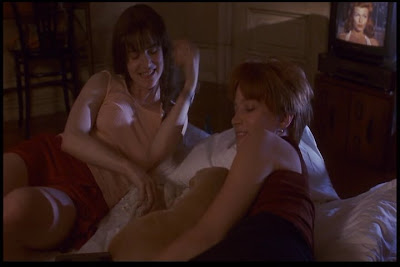

 The movie ends with Allie killing Hedy, and moving on with her life.


I suppose this end shot of a photo of the two actress' combined is meant to imply they're the same person - but the movie never really supported this claim. It followed the mainstream studio idea of 'bitches are crazy' more than offering any psychological insight. Hitchcock's POV shot of Farley Granger punching out Robert Walker at the dinner party in Strangers On A Train is a much better execution of this idea.
It's a very Patricia Highsmith like story, and I'm curious to read the novel by John Lutz to see if there were any major changes for the movie. In any case, it's an example of my favourite kind of romance - obsessive love gone wrong
 Melvin, on the very right, as one of Ernie Bilko's (Phil Silvers) collaborators Cpl. Henshaw.
Melvin was a staple on many TV shows during the 60s and 70s including The Brady Bunch, The Dick Van Dyke Show, The Andy Griffith Show and All In The Family. He was the voice of Magilla Gorilla and many other bit characters in Hanna Barbara productions like The Banana Splits, Dynomutt Dog Wonder and The Kwicky Koala Show.
To me, he was Henshaw on The Phil Silvers Show, one half of the duo that made Sgt. Bilko's schemes possible on the best TV comedy show ever produced. He will be missed.


 "I think the end of the world just came to that bag of Fritos I had in my pocket."

"He is Gregory Peck in Spellbound. He comes to take over the mental asylum, and he's nuts himself. I swear it. It's just like that picture. I took a fork and in the tablecloth in front of him, I made ski tracks and he fainted."
Nutty jokes aside, it's a movie about the meaning of life, and all that jazz, and there's a remarkable fight sequence in a bar that has Stacy Keach kicking major biker ass to save Wilson from humiliation and to teach him that good exists, and that's how you know there is a God. Or something like that.


